Every once in a while, one of my Facebook friends complains about offensive 'political' posts. I figure they don't mean posts like, 'Be sure to tell your Congressman how the new farm bill will affect your family,' so I asked a few of them what they meant by 'political.'
One cousin turned out to be referring to below-the-belt personal attacks on public figures. My reaction: Go, Jennifer! I don't have much toleration for petty personal attacks, either.
But other friends objected to links or discussions about serious matters. "I go to Facebook to escape reality," some of them said. "I don't want to have it thrown in my face here." That one makes me worry.
I certainly can understand the need to take time out from a stressful life to recharge; I think we all need that. What bothers me is that with few exceptions, the people who complain the loudest don't choose to face reality outside of Facebook, either. If workers are kept in slavery, unemployed people are being jailed indefinitely without access to lawyers, or prison inmates are being tortured, many of my friends simply don't want to know about it.
I think there's a strong perception in our culture that if we don't know something, then it doesn't exist. Judging from how much effort they devote to shutting out reality, it would seem that many Westerners have never grown up past the peek-a-boo stage. When faced with messages like, 'People are suffering; let's figure out how we can help them,' they call the messengers rude and ask them to change the subject.
So where does that leave us as writers? Should we write only about 'safe' topics and leave the slavery and torture alone? Sure, we'd be accomplices to the atrocities, but at least we wouldn't be making our readers uncomfortable. Making people uncomfortable is not nice.
Okay, let's say we choose to be part of the solution. We decide to spread the word about suffering people, and encourage brainstorming sessions on how to help. Then how do we get people to listen? How do we get past the game of peek-a-boo?

Showing posts with label Facebook. Show all posts
Showing posts with label Facebook. Show all posts
Saturday, March 23, 2013

Monday, March 4, 2013
Thank You
Today I just want to take a break from the survival posts, the observations about writing, the grammar tips and the short stories, to say thank you. Every day I'm touched by Twitter retweets, comments here and on Facebook, and recommendations that just pop up for no apparent reason. It's humbling that so many strangers enjoy my writing, and frustrating that I can't respond to each one with the time and attention you deserve. I do want you to know that I notice and I'm grateful. You make writing even more enjoyable, you make me feel connected, and you inspire me to give my best.
Tuesday, February 19, 2013
Writing Tips: How to Use Your Bio to Turn People Off
Self-proclaimed bookworm.
Aspiring writer.
Writer and author.
These are just three of the phrases in people's Twitter, Facebook or even Amazon bios that drive me crazy. I realize I'm a grammar nut and a bit of a purist, but it's not just that. These people are sabotaging their own success. I suppose I should be happy because it makes me look better in comparison, but it's hard to feel that way. Here's why they bother me:
Another thing that can turn off potential readers is using one word when you mean to use another one. Proofreading is very important (don't just rely on spell-check), but sometimes it's a matter of confusion between similar words. Here are some commonly confused ones:
And then there's the apostrophe-'s' issue. Which side of the 's' do you put the apostrophe on, or do you leave it off altogether? The answer depends on what you're trying to say. I'll get into that next time.
Aspiring writer.
Writer and author.
 |
| Photo: usf.edu |
- Self-proclaimed basically means 'I'm not calling her this; she's calling herself this.' So if you write it about yourself, what am I supposed to think?
- Aspiring means hoping. If you're an aspiring writer, then you're hoping to write. Well, stop aspiring and write already! 'Aspiring author,' is a different matter, but don't use it if you've got a book out.
- Writer and author. Since you can't possibly be an author unless you're a writer, why specify both? I can just imagine how this person's book must read: "I drove to the restaurant and steered. My wife had already arrived a few minutes earlier, and she looked lovely in a blue sleeveless dress and matching pumps, and she had clothes on. The wait was very long, but when the food came it was well worth it and acceptable. The food in that place is always delicious and edible, and both my wife and I love to eat and swallow there."
Another thing that can turn off potential readers is using one word when you mean to use another one. Proofreading is very important (don't just rely on spell-check), but sometimes it's a matter of confusion between similar words. Here are some commonly confused ones:
- Loose is an archaic word meaning release. Use it if your fantasy character has been stricken by his conscience and decides to loose all his slaves. To lose means to be defeated in a competition or to be without something that you once had.
- Could of is incorrect. You mean to say could have. Same goes for should have and would have. It's a verb phrase: 'have' is a helping verb and 'of' makes no sense there because it's a preposition.
- Insure means make arrangements for payment if something goes wrong. Your car is probably insured. Troy Polamalu's hair is insured. Ensure means make sure. You should ensure that your meat is cooked before you eat it. In a lot of states you must ensure that your car is insured before you can register it.
 |
| Photo: usatoday.net |
- Site, as a noun, means place or spot. Of course, it can also be a website: a place on the web. As a verb, it means 'put in place' or 'provide a place for.' Cite is a verb and it means reference. The related noun is citation. Sight, as a noun, is the sense we use our eyes for. As a verb, it refers to using our eyes to line up objects in a straight line. And that leads us to its other meaning as a noun: a tool we use for sighting, often called a gunsight. An example: "The dainty architect was always a welcome sight to new hires, but to the rest of us, she was a nightmare. No job was ever good enough for her, and she seemed to spend her entire time on the job site doing nothing but complaining and citing obscure regulations."
- A roll may be something to eat with dinner, the way the dice landed, a sleeping bag ready for carrying, or pretty much anything else that results from the act of rolling. A role, on the other hand, is a part to be played or a function to be carried out. If you tell me you've been 'roll-playing,' I'll think you've been playing marbles or croquet.
And then there's the apostrophe-'s' issue. Which side of the 's' do you put the apostrophe on, or do you leave it off altogether? The answer depends on what you're trying to say. I'll get into that next time.
Thursday, February 7, 2013
Survival #3: Coping Without Power
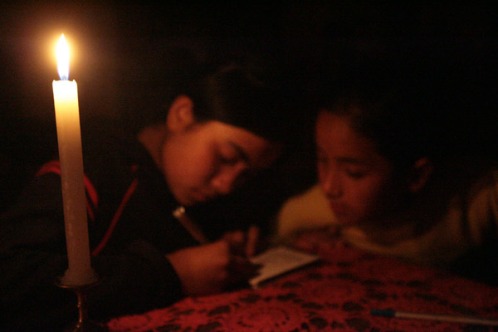
When the weather is bad and I hear about people going 'without power,' my immediate reaction is usually mild amusement. I spent about five years of my preteens and teens without electricity, and it's not so bad. But then I realize, my family was prepared for it. Our lifestyle didn't depend on electricity, and that makes a lot of difference.
 |
| Photo: dailyfinance.com |
And maybe that's why, when a line breaks and the lights go off, I don't call that being without power. Our muscles and our brains still work fine; it's only the electricity that's failed.
 |
| Photo:axisoflogic.com |
I learned a lot about how much we rely on electricity, even have trouble imagining living without it, when I asked my Facebook friends to help me come up with tips for getting along during an outage. Nearly half the people who responded made suggestions that would require electricity. Also, a lot of the discussion was focused on ways to entertain ourselves while waiting for the lights to come back on. It seems my friends thought I was talking about an outage that would last for just a day or less. I didn't realize anyone thought those little ones were worth preparing for: you just catch up on your manual chores while the daylight lasts, and go to bed at dusk. I did get some great suggestions in response to that question, but as a writer, I also learned something even better: I got a glimpse into how people think.
Tuesday, January 8, 2013
Fiction Writer Spotlight: Steven Ramirez
I'm considering starting an 'occasional series,' to borrow a newspaper term, in which I help you get to know the writers mentioned in my New Year's Day post "Fiction Writers to Watch."


Among Steven's works are a screenplay, Killers, and several short stories. His short story "Walker" will be free on Thursday and Friday (January 10th and 11th) in the US.
So I'm starting with Steven Ramirez because his short story "Walker" is going to be free this week.

Among Steven's works are a screenplay, Killers, and several short stories. His short story "Walker" will be free on Thursday and Friday (January 10th and 11th) in the US.
You can connect with Steven on Twitter (@GrimBlazer) or Facebook (www.Facebook.com/GrimBlazer), or through his blog, Glass Highway.
Saturday, December 29, 2012
Marketing for Indie Writers: Facebook Pages
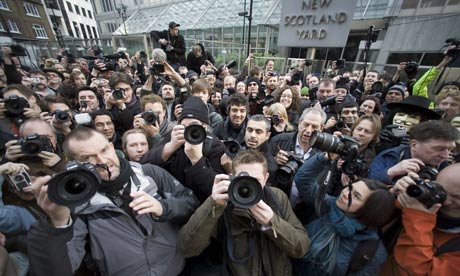
Someday I'd like to be so successful the paparazzi will do all my advertising for me. My dishes will magically wash themselves, and I can just write and eat and watch my books touch the world. Meanwhile, I use up a lot of the time I'd like to be writing in washing dishes, tidying up and trying to figure out how this whole marketing thing works.
So far, three things seem to be working: Facebook pages, a Twitter account, and this website. Of course none of them works without the other two, but here I'll focus mainly on Facebook pages.
A couple of things I've noticed:
 What I like to do:
 |
| Photo: guardian.co.uk |
A couple of things I've noticed:
- A Facebook page is not a website. I've seen authors comment that Facebook pages don't work as well as websites. That's true, in the sense that a washing machine doesn't work as well as a car.
- An empty or stale page won't help. The purpose of a Facebook page (it seems to me) is to bring your latest writing news to interested Facebook users. But,
- Nobody likes to be spammed, either. I recently had to unlike an author's page because my feed was so full of random updates about her personal life that I wasn't seeing news from other authors.
- A Facebook page is great for keeping your feeds organized. I like authors' pages as my page, not as myself, and that keeps the author updates separate from the news about my cousin's pregnant goat and my friend's latest rant about the President.
I think that with any social or grassroots medium, cooperation is key. We want likes, of course. Likes are the essential first step in getting updates out there. But after that, we want interaction. We want engagement. We want people reacting to our posts, leaving comments, and most of all, sharing our posts on their own walls. And here's where the golden rule comes in: we can't like and comment and share on our own pages. Well, we can, but it won't do much good. What works is to do it for each other. Thanks to Kev Hammond of Magic, Fairy Tales and Inter Dimensional Poking Devices for demonstrating this.
What I like to do:- Like an author's page as my page, not as myself. Not only does that help keep my feeds organized, but it helps other people find my page. I found out the hard way that if I like it as myself and my page, only my 'self' will show up in the list of 'who likes this' and people won't be able to find my page that way. Also, Facebook still calculates all my likes as just one like, no matter how many of my pages like your page. When I found that out, I had to make sure I had "Use Facebook as Jae Blakney" checked, and unlike a lot of pages.
- Check the feed from other authors' pages, leave comments and share any posts I think my fans will find interesting. I'm just starting to do this, and I haven't got the hang of it yet. If you have any advice, I could sure use it.
I'll end by passing along another tip from Kev Hammond: 'sex and bacon'. He says that when he puts that phrase in his posts, a lot more people see them. I have a hunch it's not the bacon that makes it work.
Tuesday, December 18, 2012
Hiding Behind the Christmas Tree
Decembers are so predictable: holiday cheer and holiday blues, perky music and glitzy decorations and the pursuit of the 'true meaning of Christmas'. And of course in the background, day after grinding day, the bad news doesn't stop just because it's December. With bombings in Aleppo, rockets landing on Beersheba and alleged mass murders in Colombia, the headlines read like the sickest kind of ABC book.
But then one day - last Friday to be exact - Americans took notice. People who didn't seem to care on December 13th about thousands killed in Syria or tens of thousands killed in Mexico suddenly reacted on December 14th when 28 were killed in Connecticut. It was, undeniably, a horrific event. It was shocking, gruesome and inconceivable. And so were all the other times people were shot to death, bombed to death, starved or crushed or raped or tortured in Iraq, Libya, Somalia, Haiti, Mali and elsewhere - including, of course, other locations in the United States.
I'm deeply disturbed by the Sandy Hook massacre, as I'm deeply disturbed by every instance of violence I hear about. But what disturbs me much more is the reaction I'm seeing - or, I should say, the lack of reaction. When on Friday my Facebook and Twitter feeds erupted with comments about violence after months of silence on the subject, and Google put a memorial candle on its search page where none had been the day before, I had to face a terrible truth. These people were not, as I had thought, deeply pained every day by the preventable suffering and pointless loss of life that never stops. They were not freshly goaded to hard work by each new headline. They had been looking the other way.
But hold on; it gets worse. A lot of the comments, thankfully, were attempts to brainstorm for a crowdsourced solution. But a surprising number of people actually appealed to the rest of us not to try to stop the killing. They said they needed us to let them focus on their feelings, and that there would be time for such talk after it was all over. Of course there was no reasoning with them, either, because they weren't interested in reason. They weren't motivated to stop the killing. They wanted to go back to looking the other way.
And then there were the people (I have to assume they meant well) who suggested prayer or "spiritual revival" was the answer. Now if prayer is a method of harnessing some cosmic or mystical power and directing it to accomplish specific goals, and if spiritual revival is an evil-erasing phenomenon we can simply wait for, then of course those are good answers. But the people who suggested these things are Christians. They believe in the Bible. And of course the Bible teaches that prayer without faith is useless, and 'faith' that's not demonstrated in action is nothing but hypocrisy.
Some people, it seems, have religion in their lives like they have Christmas trees in their houses. They display it where you can't help but notice, and it looks beautiful. And maybe it is a beautiful, natural thing, full of life and strength, but they've cut it off from its roots and removed it from its context. They've covered it with a variety of baggage taken from elsewhere, very attractive and eye-catching but cheap and fake on close examination. And there's probably nothing wrong with that. It's a tradition and a pretty one; it can add beauty and a sense of magic to daily life. But it's no substitute for living. It can't replace getting out of the pew and actually doing things and caring about people.
This Christmas season, though I desperately wish the terrible events of last Friday hadn't happened, it's my prayer that through this tragedy many people - especially my fellow Americans - will wake up and choose to look at what's happening to so many human beings just like us all over the world, and will choose to help stop it. If enough of us make that choice, I know we can succeed.
 |
| Photo: primeself-storage.com |
I'm deeply disturbed by the Sandy Hook massacre, as I'm deeply disturbed by every instance of violence I hear about. But what disturbs me much more is the reaction I'm seeing - or, I should say, the lack of reaction. When on Friday my Facebook and Twitter feeds erupted with comments about violence after months of silence on the subject, and Google put a memorial candle on its search page where none had been the day before, I had to face a terrible truth. These people were not, as I had thought, deeply pained every day by the preventable suffering and pointless loss of life that never stops. They were not freshly goaded to hard work by each new headline. They had been looking the other way.
But hold on; it gets worse. A lot of the comments, thankfully, were attempts to brainstorm for a crowdsourced solution. But a surprising number of people actually appealed to the rest of us not to try to stop the killing. They said they needed us to let them focus on their feelings, and that there would be time for such talk after it was all over. Of course there was no reasoning with them, either, because they weren't interested in reason. They weren't motivated to stop the killing. They wanted to go back to looking the other way.
And then there were the people (I have to assume they meant well) who suggested prayer or "spiritual revival" was the answer. Now if prayer is a method of harnessing some cosmic or mystical power and directing it to accomplish specific goals, and if spiritual revival is an evil-erasing phenomenon we can simply wait for, then of course those are good answers. But the people who suggested these things are Christians. They believe in the Bible. And of course the Bible teaches that prayer without faith is useless, and 'faith' that's not demonstrated in action is nothing but hypocrisy.
Some people, it seems, have religion in their lives like they have Christmas trees in their houses. They display it where you can't help but notice, and it looks beautiful. And maybe it is a beautiful, natural thing, full of life and strength, but they've cut it off from its roots and removed it from its context. They've covered it with a variety of baggage taken from elsewhere, very attractive and eye-catching but cheap and fake on close examination. And there's probably nothing wrong with that. It's a tradition and a pretty one; it can add beauty and a sense of magic to daily life. But it's no substitute for living. It can't replace getting out of the pew and actually doing things and caring about people.
This Christmas season, though I desperately wish the terrible events of last Friday hadn't happened, it's my prayer that through this tragedy many people - especially my fellow Americans - will wake up and choose to look at what's happening to so many human beings just like us all over the world, and will choose to help stop it. If enough of us make that choice, I know we can succeed.
Friday, December 7, 2012
An Analysis of the Cardassian Language
If you've been following me a while, you know I'm writing a novel called An Analysis of the Cardassian Language. It was born last month during NaNoWriMo, and I'm posting chapters above as they become intelligible. (At least I think so. If you find unintelligible chapters up there, please let me know.)
 So you're walking down the street one day and the next thing you know, you're lying on the floor someplace where you don't belong and you're not welcome, but you're not allowed to leave. Turns out it's a military installation, and it's not even our military. They slap a pair of handcuffs on you and ask what you're doing there, but of course that's exactly what you'd like to know.
That's what happens to Faine Channing in Cardassian Language. She's in Chicago about to go home to her kids, and then she wakes up on a space station. Fans of Star Trek: Deep Space Nine will be interested to know that the station is Terok Nor, or Deep Space Nine when it was still being run by the Cardassians. Of course, we're at war with the Cardassians, which doesn't make life any easier for Faine.
That's what happens to Faine Channing in Cardassian Language. She's in Chicago about to go home to her kids, and then she wakes up on a space station. Fans of Star Trek: Deep Space Nine will be interested to know that the station is Terok Nor, or Deep Space Nine when it was still being run by the Cardassians. Of course, we're at war with the Cardassians, which doesn't make life any easier for Faine.
NaNoWriMo is pretty intense, and like many wrimos I took a week off from writing after it ended on November 30th. Meanwhile I gave Faine her own Facebook page and started having a little fun with pictures. Today I plan to jump back into the text. Be on the lookout for more tabs above.
Sunday, December 2, 2012
Connect with Faine on Facebook
Faine Channing, chief unfortunate of the novel-in-progress An Analysis of the Cardassian Language, now has her own Facebook page. Give her a 'like' to keep in touch with her (or just get the latest news on Analysis).
Subscribe to:
Posts (Atom)