Showing posts with label Michael Lane. Show all posts

Tuesday, June 25, 2013

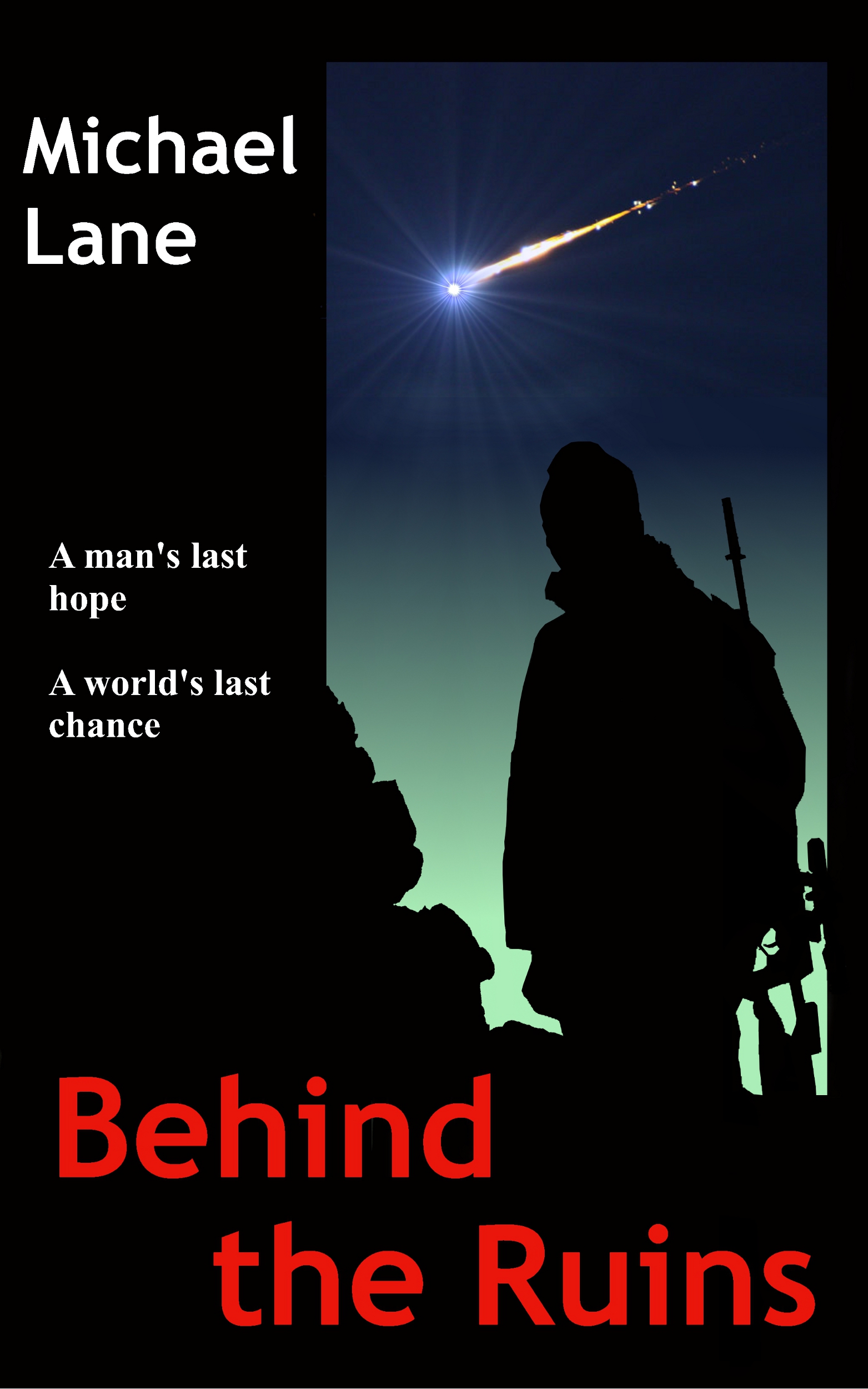
Book Review: Behind the Ruins by Michael Lane

I just finished reading Behind the Ruins by Michael Lane. I don't make it a habit to review books, but I liked this one so much I thought I'd tell you about it.

I found the book because I was looking for indie fiction that was at least halfway decent. I'd been slogging through a wilderness of awful ramblings, and when I came across Behind the Ruins I didn't hold out much hope. Why would this one be different? Then I read the first few chapters and realized that while it was still entirely possible there was no plot, at least the characters, the setting and the narrative were a great read for now.

And it turned out there is a plot. I won't tell you what it is, but it swept me up.

The Premise

Here's the blurb from the virtual 'jacket':
The world didn’t end when the meteors came; it changed. 

We meet Grey in the process of killing three people intent on robbing and murdering him. The deaths solve nothing; instead, what he finds on one of the bodies leads to a bloody trip through the wreckage of a world scarred by a near-apocalypse, and inward through his own memories. In the process he becomes involved in a plan that could mean the return of the world he knew as a child, in the time before the Fall.

During his trek from British Columbia into the former United States he must overcome both his own bleak memories and the murderous forces of an old friend. The lessons he takes away and the decisions he makes will determine not only if he has a future, but whether civilization does.

What I Liked

In no particular order, I liked the characters, the plot, the pacing and the setting.

The people in the book seemed very real. They were easy to tell apart by their distinct personalities and habits of speech, and they had complexities, layers and even inconsistencies, like you and I do.

The plot struck me as well-organized without being either contrived or obvious. I kept guessing what was going to happen, and I kept being wrong, which I consider a good sign. And when the book was over, I thought, "Yes, that is probably what would end up happening, if these people were in this situation."

The pacing felt right. It was slow enough to feel gritty and real: I felt forced to relate to the cold and heat, the dirt, the indecision and the dread. And it was fast enough not to make me feel bogged down or bored. There was, perhaps, one section of necessary explanation that dragged a little, but maybe it didn't. I was tired when I read that part, so maybe it was just me.

Michael Lane lives in western Canada, and the story takes place in the borderland of southern British Columbia and northern Washington State. To be honest, it annoys me a little when novel after novel is set in either New York, Los Angeles or a big-city concept of what a 'small town' must be like (yup, I'm talking about Forks, Washington). Michael wrote about his homeland, and that makes a difference in the quality of the book.

What I Didn't Like

Behind the Ruins has the same problem my own books have: a crying need for editing. In fairness, I do not have the latest version, and some of the errors may have been fixed since I downloaded it. Editing is just not one of those things an author can do for his own work. It's one of the growing pains of the indie author/publisher movement. And, yes, we're working on that.



Wednesday, February 13, 2013

Quantity and Quality: On Writing Quotas

When I asked novelist Michael Lane if he had learned any lessons he wanted to pass on to other writers, he said, "Set a daily word-count and meet it, even if you’re writing absolute garbage that day. If you do that, you’ll finish, and once it’s done there’s no passage so bad you can’t go back and fix it." From what I've seen, Michael's in good company: word count is a pretty common measurement for writers to use in setting quotas for themselves.


Photo: bookdirtblog.blogspot.com
When I was doing the first draft of my current book, a word count quota worked perfectly. The only important thing was to get the ideas down. Clarity, completeness, voice and all that were optional at that point, and getting the details right was not even a consideration.

When I started doing the second draft, I didn't give myself any quotas at all beyond knowing I needed to get it done before NaNoWriMo '13. I waited until I felt recharged after NaNoWriMo '12 and started in with enthusiasm about a week into December. But without a standard to measure my progress by, I alternately floundered and obsessed. By the middle of January it was more than clear that I needed to set some sort of quota.

But word count wasn't going to do it, for two main reasons:

  • Overall, the second draft expands on the first, but passages of the first draft are ridiculously wordy, redundant or just need to be removed, so some days the word count goes down instead of up.
  • This is a Star Trek novel. That means I have a huge body of already-established particulars to follow, from timelines and events to technology, cultural thinking and of course, the Cardassian language itself. And thanks to a not-entirely-unearned genre stereotype, I'm zealous about protecting my reputation by not letting the novel degrade into an inaccurate hack-job. Sometimes a single sentence can represent several hours of research.
Thanks to Paramount
After a few weeks of mulling it over and some help from my brother, I decided to try these simple requirements:
  1. Write something each day, six days a week, even if it's just a couple of sentences. This keeps my head in the story so I don't lose momentum. And more often than not, writing those obligatory 'couple of sentences' has gotten my thoughts flowing and turned out quite a bit of work for the day after all. As for that seventh day, sometimes I need to take time away from the story to gain a little perspective or refresh my mind.
  2. Stay on track to finish this draft and the related screenplay Quicksilver before November. I'm about two months into this draft and a little over a quarter done. At this rate I should finish in early August and have plenty of time for the screenplay - not that I have to do them in that order, of course.
Photo: aphroditespriestess.blogspot.com
The plan is so simple and general I wasn't confident it would work, but I've been doing it for about two weeks now and it's going great. My writing productivity has shot up and I'm able to relax and enjoy it instead of worrying whether I've done enough yet.

What kind of quotas do you set for yourself? If you use word count, how do you account for time spent on research and the need to cut or consolidate a passage from a previous draft? Or, to put it another way, how do you resist the temptation to be sloppy with your details or leave bloated passages untouched?

(This episode was brought brought to you by the letter Q.)

Sunday, January 27, 2013

Meteors, Mariners and Monkeys

It's been a while since I told you what I'm up to, so here's a quick update:

Reading:

I'm currently reading Behind the Ruins by Michael Lane. It's about life in southern Canada after meteors destroy life on earth as we know it.

Next in line is Walker, a horror story by Steven Ramirez, then a historical novel written in Spanish, La Muerte de Los Trece Bomberos (The Death of the Thirteen Firefighters) by Dante Romero Siña. 

Writing:

Progress on my novel, An Analysis of the Cardassian Language, has been slow for the past month, but I'm starting to pick up the pace again. One part I'm looking forward to writing is a series of short stories the main character writes for her children, about a race of lab-created humanoids who live at the bottom of the ocean. 

Other Things:

Along with M. Joseph Murphy, I'm working on starting up Suckers Guild, a way for indie writers to barter for the expert services we need, to produce truly professional books. For more on that, see these posts, and please help make the guild better by taking the survey. Thanks!


Tuesday, January 22, 2013

Fiction Writer Spotlight: Michael Lane

I'm delighted to say that Michael Lane, indie author of the thriller Behind the Ruins, has consented to an interview:


Jae: Why do you write fiction? What got you started and what do you think influenced you to take up fiction writing?

Michael: I wish I could remember who said this originally, but the gist was that writers write fiction to tell the truth and write nonfiction to lie. Which sounds mean and horrible but I think the underlying concept is that “great truths” – emotional, philosophic or cultural – are best tackled in fiction, where you can set up your morality play to best illustrate your point. In a weird way working as a journalist returned my interest to writing fiction, since I can examine concepts in fiction that can’t be touched in print or broadcast media. I got to do that in Behind the Ruins and really enjoyed it.

Jae: What are some of your favorite books?

Michael: Mervyn Peake’s Gormenghast novels, Glen Cook’s Black Company books, anything by Gene Wolfe, Leviathan by Paul Auster, Survivor by Chuck Palahniuk, McCarthy’s Blood Meridian, the first Gunslinger volume by Stephen King.

Jae: What's your career background, and do any of your work experiences show up in your writing?

Michael: I am a print journalist by training and work experience, which affects my grammar and word choice while writing. I tend to stay as lean and minimalistic as I can, avoid adverbs and minimize extraneous description or dialogue. Shorter is better.

Jae: Is Behind the Ruins your first novel?

Michael: It’s the first I finished. I can’t count the false starts, but that’s the norm for writers I’ve talked to. Making the mental commitment to finish is the tricky part. Writing is cake in comparison.

Jae: What's Behind the Ruins about?

Michael: It’s about a man trying to recover some sense of his humanity in an extremely violent post-apocalyptic world. I wanted to explore how violence as a tool can ensure your survival while emotionally and psychologically killing you. That the learning process is also a violent one hopefully makes people ask some more involved questions.

Jae: What setting did you choose for the story, and why?

Michael: It’s post-apocalyptic only because the desperate struggle for survival is integral to who the main character had become. It could have been set in the old west or the Crusades, I suppose, but that brings in some cultural, historical and genre baggage I wanted to avoid.

Jae: Do you think in concepts, pictures or words? If words, are they spoken or written?

Michael: When writing I think in both pictures and words. I tend to read (and write) in a spoken meter and try to “hear” the language. My early thinking on a story is almost pure imagery and visualization.

Jae: Tell me about your writing process.

Michael: I usually make a set of rough notes that are largely limited to character names and notes, a few brief notes on major locations and environments and that’s it. Then I write. I find that if I do a detailed outline I’ve told myself the story and won’t want to do it again in the initial draft. It sucks a lot of the life out for me. Behind the Ruins had a one-page character listing and a second sheet of location and technology notes. Those grew a bit over the course of writing the novel. When I’m writing, I religiously do 3,000 words a day.

Jae: How is the fiction process different from journalism?

Michael: It’s less deadline oriented, but it’s certainly similar in many ways. You have to get work done, get it done on a schedule, and it has to be clean, so speed and accuracy are both shared goals. The difference is the freedom to make your own story and tell the truth as you see it, rather than as four cited authorities see it.

Jae: What were your worst moments writing Behind the Ruins?

Michael: The first draft edit, which is the hairy one with major revisions, lots of language alteration and hair-pulling.

Jae: What were your best moments?

Michael: Finishing the first draft edit and realizing there was a good book in there despite all I’d done to it.

Jae: What important lessons have you learned as a writer that you'd like to pass on to others?

Michael: Set a daily word-count and meet it, even if you’re writing absolute garbage that day. If you do that, you’ll finish, and once it’s done there’s no passage so bad you can’t go back and fix it. Keep moving forward.

Jae: What's next for you? Is there another novel in the works?

Michael: There are. I have two started. One is a fantasy novel in its earliest stages, and likely the first of two or three in a series, while the other is a stand-alone thriller that’s about eighty pages in at the moment. I do want to revisit the world of Behind the Ruins, as well.


Tuesday, December 4, 2012

Guest Post: How to Edit

Please help me welcome today's guest blogger, Michael Lane:

Greetings, all. What follows is a summary of some of those rules of editing I bring with me from my print journalism background.

While print is following the 8-track into oblivion, many lessons learned in the land of the five W's carry into any form of prose writing. So, let me sum up what my decade-plus of banging keys on a deadline taught me.

Ask for criticism – In a newsroom this comes with the coffee-stains and bottles of Tums. Once you’re writing for yourself it’s easy to be timid. An average writer will worry that readers will hate their story. What makes a good writer is the hunger to hear that hate and use it to make their writing better.

One caveat: If someone has a specific gripe “I think Mr. Thomason is unbelievable and flat as a character” – look at it and see if you need to fix it. If they say “I didn’t like it, horror stories suck,” then ignore them. That’s an opinion, not a criticism. In either case, try not to take it to heart; use it.

Adverbs - To steal from Stephen King’s “On Writing” (which you should own, read and memorize), kill these buggers whenever you see them. ‘Softly, angrily, dishearteningly’ and so on and so forth. Your dialogue and narration will set the scene and the mood – show the emotions people are feeling, don’t tell the reader what they are. They make a sentence weak, and that leads us into the next point.

Don’t use passive verbs – This is one of the nicest habits I brought out of journalism – avoidance of the verb “be” in all its many forms. Stay away from it. It’s evil. Never Trixie was ignored by Frank, always Frank ignored Trixie.

Be direct, get it done - You must be direct as a reporter, unless you’re writing a column, and that’s another great benefit of working in the industry. Brevity really is the soul of wit. You can embellish at points, but most stories are better for the absence of well-written but baroque prose.
Papers also teach that deadlines are real. You need to get it done, but don’t feel like it? Do it anyway. Your readers don’t want to hear that you were under the weather or depressed over the final episode of your favorite show. It’s a job, treat it like one and you’ll get better at it.

Grammar is not your enemy - You’re a creative writer, so you can break the rules, but avoid it if you can. I’m prone to sentence frags, because I think and talk that way. I left you one up above; did you notice it?
‘Softly, angrily, dishearteningly’ and so on and so forth.
That’s a frag. I’d go back and edit it but I like frags in some situations.
Determine your grammatical weak points and work on them. The same goes for punctuation. Run out and find a copy of Diana Hacker’s A Writer’s Reference – the spiral-bound one. Every writer should have one.

Be willing to cut - We all love our stories, but when it’s rewrite time, cut that word count down. If a section doesn’t advance the story, or define something vital, it needs to shrink or go away entirely.


And now, for a guest appearance by H.P. Lovecraft as editing victim of the day:


Photo: Alibris.com
“To declare that we were not nervous on that rainy night of watching would be an exaggeration both gross and ridiculous. We were not, as I have said, in any sense childishly superstitious, but scientific study and reflection had taught us that the known universe of three dimensions embraces the merest fraction of the whole cosmos of substance and energy. In this case an overwhelming preponderance of evidence from numerous authentic sources pointed to the tenacious existence of certain forces of great power and, so far as the human point of view is concerned, exceptional malignancy. To say that we actually believed in vampires or werewolves would be a carelessly inclusive statement. Rather must it be said that we were not prepared to deny the possibility of certain unfamiliar and unclassified modifications of vital force and attenuated matter; existing very infrequently in three-dimensional space because of its more intimate connection with other spatial units, yet close enough to the boundary of our own to furnish us occasional manifestations which we, for lack of a proper vantage-point, may never hope to understand.” (-- The Shunned House)


I know, it’s Lovecraft. Grammatically it’s textbook correct, but let’s rewrite it anyway.

We were scared, I won’t deny it. Neither of us was superstitious, but with science discovering the God Particle this year, who knew? The stories, what we had seen, everything we knew, pointed to something both strange and evil. We didn’t think it was a werewolf or a vampire. We weren’t idiots. But there was something there, something that – just maybe – no one had ever seen before. Something we couldn’t understand from somewhere we couldn’t go.


The good editors among you noted the passage is still in a passive voice, but there’s only so much you can do with Lovecraft. The experiment was to keep as much of the original passage’s meaning - and atmosphere - as we could with as few words as possible.

Now go write something and have fun while you do. Then edit the heck out of it.

Michael Lane

http://realmichaellane.blogspot.ca/

@Michael_M_Lane on Twitter