Showing posts with label Lovecraft. Show all posts

Friday, July 19, 2013

Interview with Novelist Sean P Wallace

M Joseph Murphy interviews Sean P Wallace, author of the YA novel Deep Echoes:

I recently had the privilege of interviewing Sean P.Wallace, author of the YA science fiction novel Deep Echoes. I thoroughly enjoy his blog. Make sure you check it out. (See link at end of article)


Sean P. Wallace - author, Deep Echoes

1. Where did the concept for your novel, Deep Echoes, come from? It is a Young Adult Fantasy/Science Fiction novel. Do you read much YA? If so, what books are your favorites?

This is a complex question, sadly! Deep Echoes started a long time ago with another book, an attempt to produce serialized fiction on my website. This transformed into its own, non-serialized book, a book which I ultimately decided I didn't like as it was set too late in my chronology. But I loved the world I created, the world of Geos, and didn't want to let it go with that book. So, an event mentioned in that book was planted in my imagination and became, after much work, Deep Echoes.
  
2. You recently redid the cover for Deep Echoes. What made you change it? Was this process different choosing a cover the second time around?

I changed it because I decided that the old cover looked like what it was: a cover made by someone who didn't have much artistic talent. Me! It occurred to me that the cover wasn't helping to get people to read the book, something I desperately want, so I contacted a designer friend and commissioned a new cover. I had an idea of what I wanted for Deep Echoes and he realized that for me. It was a simple, professional transaction: exactly what you'd want from such an exchange!
Deep Echoes - New Cover
 3. One of my favorite posts on your blog was about your struggle to allow yourself to be an artist. What you call the “black noise” or the “anti-art” is something most creative people struggle with. How do you cope with it? Have you thought about what accomplishment in your life could shut this noise down for good?

The main way I cope with it is through music. There are certain songs that can lift me, put me into a better state of mind, and that can help me to be creative. Where I'm struggling more so than usual, I'll pick a soundtrack from a film in the same genre as my book - I used Western soundtracks for writing Dust and Sand, a novel serialized on Geek-Pride.co.uk - and that will often do the trick instead.


4. You mentioned wanting to make a film. What kind of film? Who are your film-making heroes?

I had grand ideas but I also have very good friend who've grounded me a little, advised me to live in the real world and get experience of filmmaking and the industry. As such, I'm going to do a film-making course and start with short films before deciding on the right script I could make with the budget.

My art style, no matter what the story, is to tell stories of the fantastic, of the strange and the outrĂ©, and use them to make deeper points. As such, I prefer to write and read Speculative pieces, and would expect any film I write to be such: Horror, Fantasy of Sci-Fi.

My film-making hero would be Kevin Smith, of Clerks and Dogma fame. He is an inspiring speaker, artist and human being. If you don't mind cursing and dirty humour, I'd recommend you check out his Smodcast podcast empire!

Kevin Smith
5. One thing my readers will be very interested in is your choice to sell your book directly on your site. You suggest they pay what they are willing through a “donate” option. Your book is also available on Amazon. How has your experience been with the donate option?

Without putting too fine a point on it, non-existent. This isn't something which troubles me though: as I said before, I just want people to read Deep Echoes. I think you need to be a far more established artist than I for Pay If You Like to provide any meaningful experiences. Still, I like having the option available.


6. Lastly, your most recent blog post speaks very strongly about why you are boycotting Orson Scott Card’s Ender’s Game. Why do you think some people are willing to overlook the bigotry of an artist because their books are interesting?

I have a small amount of trepidation on this topic, as I count H.P. Lovecraft as one of my favourite writers and he was a horrible racist, something which comes out through much of his work. At first, I was willing to overlook that aspect of his work but, as I grew and learned more of concepts such as Privilege, I found that I could not ignore those parts of his work. I haven't read one of his stories for many years now, and doubt I'll do so, because I can't stomach the attitudes which come across in the piece.


I think the reluctance on some people's part not to condemn Card is a fear/feeling that it reflects on them: the idea that they are being accused of being homophobic for liking Ender's Game. They don't appreciate that it is possible to enjoy a piece of media whilst still recognizing its more troubling faults, and so they become defensive.
Orson Scott Card
 The reason people can overlook the bigotry of an artist is, I imagine, that the bigotry doesn't play a part in the work being produced. It probably surprised many to find out about Card's homophobic views - I know I hadn't heard about them until the recent Superman debacle - because he was a Science Fiction writer:people often go to Science Fiction to find a world with more advanced, enlightened views, and perhaps found some of them in Ender's Game.


Then there's the concept of Free Speech, particularly when this is combined with religiously-inspired beliefs: people don't like views being denounced because of this strange idea that an opinion can't be wrong. Despite it being patently the case that they can be disproven (through scientific studies, statistics, etc.) were I to guess, I'd say that people don't like opinions being fair game for dismissal and being disproved because that might mean their own ideas are fair game.


But I'd say it's the bigotry not being clear and obvious that makes the biggest difference.


Links:
Sean P. Wallace on Amazon
Sean P. Wallace on Smashwords
Sean P. Wallace Free Books (or Donation)
Sean P. Wallace Blog
Sean P. Wallace on Twitter

Tuesday, December 4, 2012

Guest Post: How to Edit

Please help me welcome today's guest blogger, Michael Lane:

Greetings, all. What follows is a summary of some of those rules of editing I bring with me from my print journalism background.

While print is following the 8-track into oblivion, many lessons learned in the land of the five W's carry into any form of prose writing. So, let me sum up what my decade-plus of banging keys on a deadline taught me.

Ask for criticism – In a newsroom this comes with the coffee-stains and bottles of Tums. Once you’re writing for yourself it’s easy to be timid. An average writer will worry that readers will hate their story. What makes a good writer is the hunger to hear that hate and use it to make their writing better.

One caveat: If someone has a specific gripe “I think Mr. Thomason is unbelievable and flat as a character” – look at it and see if you need to fix it. If they say “I didn’t like it, horror stories suck,” then ignore them. That’s an opinion, not a criticism. In either case, try not to take it to heart; use it.

Adverbs - To steal from Stephen King’s “On Writing” (which you should own, read and memorize), kill these buggers whenever you see them. ‘Softly, angrily, dishearteningly’ and so on and so forth. Your dialogue and narration will set the scene and the mood – show the emotions people are feeling, don’t tell the reader what they are. They make a sentence weak, and that leads us into the next point.

Don’t use passive verbs – This is one of the nicest habits I brought out of journalism – avoidance of the verb “be” in all its many forms. Stay away from it. It’s evil. Never Trixie was ignored by Frank, always Frank ignored Trixie.

Be direct, get it done - You must be direct as a reporter, unless you’re writing a column, and that’s another great benefit of working in the industry. Brevity really is the soul of wit. You can embellish at points, but most stories are better for the absence of well-written but baroque prose.
Papers also teach that deadlines are real. You need to get it done, but don’t feel like it? Do it anyway. Your readers don’t want to hear that you were under the weather or depressed over the final episode of your favorite show. It’s a job, treat it like one and you’ll get better at it.

Grammar is not your enemy - You’re a creative writer, so you can break the rules, but avoid it if you can. I’m prone to sentence frags, because I think and talk that way. I left you one up above; did you notice it?
‘Softly, angrily, dishearteningly’ and so on and so forth.
That’s a frag. I’d go back and edit it but I like frags in some situations.
Determine your grammatical weak points and work on them. The same goes for punctuation. Run out and find a copy of Diana Hacker’s A Writer’s Reference – the spiral-bound one. Every writer should have one.

Be willing to cut - We all love our stories, but when it’s rewrite time, cut that word count down. If a section doesn’t advance the story, or define something vital, it needs to shrink or go away entirely.


And now, for a guest appearance by H.P. Lovecraft as editing victim of the day:


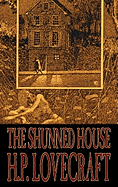
Photo: Alibris.com
“To declare that we were not nervous on that rainy night of watching would be an exaggeration both gross and ridiculous. We were not, as I have said, in any sense childishly superstitious, but scientific study and reflection had taught us that the known universe of three dimensions embraces the merest fraction of the whole cosmos of substance and energy. In this case an overwhelming preponderance of evidence from numerous authentic sources pointed to the tenacious existence of certain forces of great power and, so far as the human point of view is concerned, exceptional malignancy. To say that we actually believed in vampires or werewolves would be a carelessly inclusive statement. Rather must it be said that we were not prepared to deny the possibility of certain unfamiliar and unclassified modifications of vital force and attenuated matter; existing very infrequently in three-dimensional space because of its more intimate connection with other spatial units, yet close enough to the boundary of our own to furnish us occasional manifestations which we, for lack of a proper vantage-point, may never hope to understand.” (-- The Shunned House)


I know, it’s Lovecraft. Grammatically it’s textbook correct, but let’s rewrite it anyway.

We were scared, I won’t deny it. Neither of us was superstitious, but with science discovering the God Particle this year, who knew? The stories, what we had seen, everything we knew, pointed to something both strange and evil. We didn’t think it was a werewolf or a vampire. We weren’t idiots. But there was something there, something that – just maybe – no one had ever seen before. Something we couldn’t understand from somewhere we couldn’t go.


The good editors among you noted the passage is still in a passive voice, but there’s only so much you can do with Lovecraft. The experiment was to keep as much of the original passage’s meaning - and atmosphere - as we could with as few words as possible.

Now go write something and have fun while you do. Then edit the heck out of it.

Michael Lane

http://realmichaellane.blogspot.ca/

@Michael_M_Lane on Twitter